





Luminys - LCE-PLSV - LumiCenter Plus Video Management System
Product Overview
Luminys LCE-PLSV is a video channel license for LumiCenter Plus VMS that enables capture, display, recording, transmission, and playback of one IP camera or device channel. LumiCenter Plus supports up to 30 servers, unlimited cameras, real-time object tracking analytics, edge metadata processing, and edge storage playback.
Key Configuration
• License type: One (1) video channel for LumiCenter Plus VMS
• Maximum servers in the distributed system: Up to 30 for LumiCenter Plus
• Maximum cameras per server: Unlimited
• Supported OS: Windows 11/10, Windows Server 2022/2019, Linux (Ubuntu 22/20/19/18, Debian 12/11/10 upon request)
Key Features
Supports automated device discovery and simultaneous recording with real-time monitoring using separate streams for display and storage. Enables pre-event recording, multi-camera synchronous playback, and variable-speed forward/reverse playback. Includes analytics-based archive navigation, event tagging, and configurable event responses such as alarms, relay triggers, PTZ presets, notifications, and audio output. Provides multi-user access control, widescreen/touch UI support, cloud remote monitoring, and deep-learning analytics for fire/smoke and human/vehicle detection. Supports Intel Quick Sync hardware decoding, LDAP authentication, bulk camera configuration, and decentralized storage architecture with failover redundancy (1+1, N+1, N+M).
Technical Context
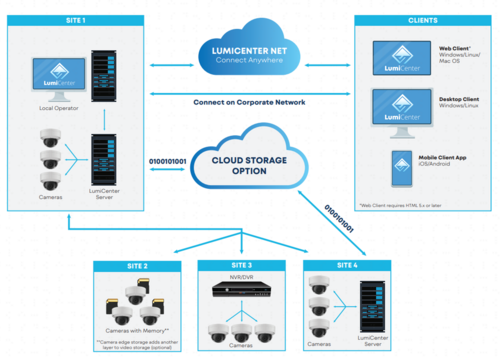
LumiCenter Plus uses a micromodule-based decentralized architecture for improved system resilience. SolidStore file system is optimized specifically for efficient video storage management. AutoStream dynamically adjusts bandwidth based on network conditions. Supports up to 30 distributed servers with unlimited cameras and client connections. Includes macro-based automation for event responses such as PTZ control, relays, recording, and alerts.
Installation Notes
Supports Windows 11/10 and Windows Server 2022/2019 editions, plus Linux distributions such as Ubuntu and Debian. Client access available via Windows desktop app, Chrome web browser, and iOS/Android mobile apps. Runs on x86 and x64 CPU architectures with Intel Quick Sync hardware decoding support. Scalable to unlimited PTZ devices, POS event sources, audio channels (hardware dependent), object tracking targets, LPR, and face recognition channels.
| System Scalability | |
|---|---|
| Maximum Number of Servers in the Distributed System | Up to 30 for Basic and Plus; Unlimited for Max |
| Clients that support simultaneous connection to the server | Unlimited |
| Servers that simultaneously transmit video images to a client | Unlimited |
| Camera views displayed simultaneously on a client's screen | Unlimited |
| Video input channels per server | Unlimited |
| Simultaneously processed signals from microphones | Unlimited |
| Audio output channels (speakers, headphones, etc.) | Refer to your sound card specifications |
| PTZ devices used | Unlimited |
| Event sources (POS devices) | Unlimited |
| Objects simultaneously tracked by the Object tracker | Unlimited |
| License plate recognition channels | Unlimited |
| Face recognition channels | Unlimited |
| Device Support | |
| IP Devices | More than 3,000 models supported including proprietary protocols and ONVIF profiles G, M, S and T |
| Analog Devices | Supported via DVRs and encoders |
| CPU | 32-bit (x86), 64-bit (x64) |
| Video | |
| Video compression algorithms | MJPEG, MPEG-2, MPEG-4, MxPEG, H.264, H.265, Motion Wavelet |
| Maximum resolution support | 8MP (4K) |
| Embedded video camera video analytics | Supported |
| Touch-sensitive monitors | Supported |
| Core Functions | |
| • Automated device discovery • Pre-event video recording • Simultaneous recording to storage and real-time surveillance • Capability to use different streams from a camera for recording and display • Capability to choose the write location and recording parameters for various camera events • Synchronous playback of video footage recorded by several cameras • Playback with fast- or slow-motion in forward or reverse • Audio and video analytics • Archive navigation through events recognized by video analytics or tagged by operators • Event-driven response scenarios: recording, alarm generation, activation of relays and starting PTZ camera through user-defined presets, notifications via SMS, e-mail, or through camera speaker output. Continuous or alarm recording (including one initiated by an operator) • Multi-level user rights • Support for widescreen displays and cameras, and touch screen displays • Interface Languages: English, French, Spanish \n | |
| Special Features | |
| • Cloud service for remote monitoring and situational awareness • Deep learning video analytics (fire and smoke detection, human and vehicle detection) • Multiple criteria forensic search of recorded video • Face and license plate search • Motion events summary • AutoStream™ bandwidth optimization technology • Support for Intel Quick Sync hardware video decoding • UDP and multicast video streaming • Motion detection recording by default • Bulk configuration of cameras • Support for LDAP authentication • SolidStore, a proprietary, highly-efficient file system for video storage • Micromodule-based and decentralized architecture for unprecedented reliability • Supported failover redundancy types: 1+1, N+1, N+M \n | |
| System Requirements - Servers | |
| Windows OS | Windows 11³: Home, Pro, Education, Pro Education, Pro for Workstations, Enterprise Windows 10: Pro, Enterprise, Education, Home Edition |
| Windows Server OS | Windows Server 2022³: Standard, Essentials, Datacenter, Azure Datacenter Windows Server 2019³: Essentials¹, Standard, Datacenter |
| Linux OS (Available Upon Request) | Ubuntu: (22, 20, 19, 18) Debian: (12, 11, 10) |
| System Requirements - Clients | |
| Desktop Client | Windows 10, Windows 11 |
| Web Client | Google Chrome, Latest version of Windows 10 and 11 |
