
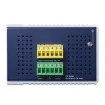
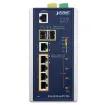
Planet - IGS-5225-4UP1T2S - Industrial L2+ 4-Port 10/100/1000T 802.3bt PoE + 1-Port 10/100/1000T + 2-Port 100/1000X SFP Managed Switch
Product Overview
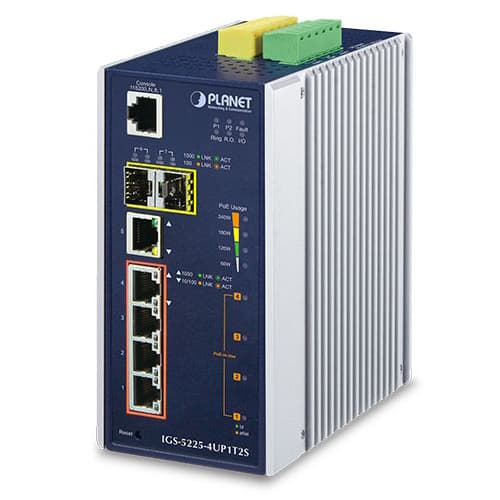
The Planet IGS-5225-4UP1T2S is an industrial L2+ managed PoE++ switch with 4 802.3bt ports (95W each, 240W budget), 1 Gigabit copper port, 2 SFP ports, and 14 Gbps fabric. It features five PoE modes, ERPS (<10ms recovery), DI/DO, Modbus TCP, IEEE 1588v2 PTP, and -40°C to 75°C operation.
Key Configuration
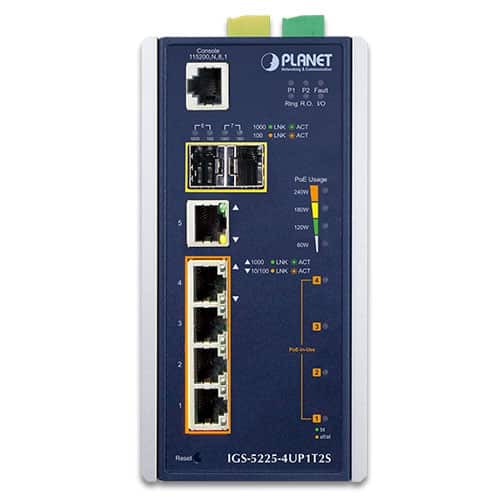
• Copper ports: 4 × 10/100/1000BASE-T 802.3bt PoE++ (ports 1–4), 1 × 10/100/1000BASE-T (port 5).
• SFP ports: 2 × 100/1000BASE-X SFP (supports 100BASE-FX compatibility).
• PoE budget: 240W max; per-port output up to 90W (802.3bt), 95W (UPoE), 36W (802.3at), 60W (Force mode).
• PoE modes: 802.3bt, UPoE/PoH, End-span (30W), Mid-span (30W), Force (60W).
• Switch fabric: 14Gbps; throughput: 10.42 Mpps.
• Dimensions: 76.8 × 107.3 × 152 mm; weight: 1050 g.
Key Features
This industrial switch delivers 802.3bt PoE++ up to 95W per port for PTZ cameras, AIO PCs, PoE lighting, and digital signage. It offers five selectable PoE modes for compatibility with 802.3bt, UPoE, 802.3at, and non-standard 4-pair devices, plus PoE usage LEDs (60/120/180/240W), PD alive check, and scheduled power recycling.
Technical Context
ERPS provides sub-10ms ring recovery, with IPv4/IPv6 static routing (8 VLAN interfaces, 32 entries), IEEE 1588v2 PTP, Modbus TCP for SCADA, and ONVIF support. VLAN includes 802.1Q (255 groups), Q-in-Q, and private VLAN, with link aggregation (3 groups, 3 ports each), IGMP/MLD snooping, and 8 priority QoS queues.
Installation Notes
The IP30 aluminum housing (DIN-rail/wall-mount) operates from -40°C to 75°C, with dual 48–56V DC inputs (>52V for PoE++), 6.6W system draw, and 282W full PoE load. Security features 802.1X, RADIUS/TACACS+, and ACLs (123 entries), with management via console, Web, Telnet, SNMP, SSHv1/v2, and TLS/SSL. DI/DO provides 2 inputs, 2 outputs, and an alarm relay (1A @ 24V DC), with 6KV ESD protection and TAA compliance.
| Hardware Specifications | |
|---|---|
| Hardware Version | 4 |
| Copper Ports | 5 10/100/1000BASE-T RJ45 auto-MDI/MDI-X ports |
| SFP/mini-GBIC Slots | 2 1000BASE-SX/LX/BX SFP interfaces (Port-6 to Port-7) Compatible with 100BASE-FX SFP |
| PoE Injector Port | 4 ports with 802.3bt PoE++/802.3at PoE injector function with Port-1 to Port-4 |
| Console | 1 x RJ45-to-RS232 serial port (115200, 8, N, 1) |
| Switch Architecture | Store-and-Forward |
| Switch Fabric | 14Gbps/non-blocking |
| Throughput (packet per second) | 10.42Mpps@ 64 bytes packet |
| Address Table | 8K entries, automatic source address learning and aging |
| Shared Data Buffer | 4Mbits |
| Flow Control | IEEE 802.3x pause frame for full-duplex Back pressure for half-duplex |
| Jumbo Frame | 9Kbytes |
| Reset Button | < 5 sec: System reboot > 5 sec: Factory default |
| ESD Protection | 6KV DC |
| Enclosure | IP30 aluminum case |
| Installation | DIN-rail or wall mounting |
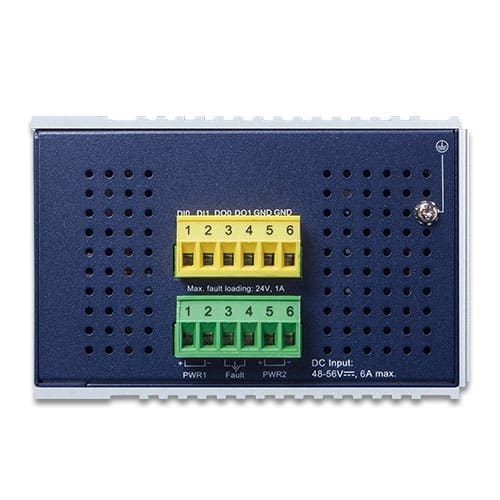
| Connector | Removable 6-pin terminal block for power input Pin 1/2 for Power 1, Pin 3/4 for fault alarm, Pin 5/6 for Power 2 Removable 6-pin terminal block for DI/DO interface Pin 1/2 for DI 1 & 2, Pin 3/4 for DO 1 & 2, Pin 5/6 for GND |
| Alarm | One relay output for power failure. Alarm relay current carry ability: 1A @ 24V DC |
| 2 Digital Input (DI) | Level 0: -24V~2.1V (±0.1V) Level 1: 2.1V~24V (±0.1V) Input load to 24V DC, 10mA max. |
| 2 Digital Output (DO) | Open collector to 24V DC, 100mA max. |
| vLED Indicator | System:
Per 10/100/1000T RJ45 Ports: Per SFP Interface: Per PoE Port: PoE Usage: |
| Dimensions (W x D x H) | 76.8 x 107.3 x 152 mm |
| Weight | 1050g |
| Power Requirements | Dual 48~56V DC (>52V DC for PoE+ output recommended) |
| Power Consumption | Max. 6.6 watts/22.52BTU (Power on without any connection) Max. 282 watts/962.22BTU (Full loading with 802.3bt PoE++ function) |
| Power Over Ethernet | |
| PoE Standard | IEEE 802.3bt PoE++ Type-4 PSE |
| PoE Power Supply Type | 802.3bt/End-span/Mid-span/UPoE/Force |
| PoE Power Output | 802.3bt PoE++ – Per port 52V~56V DC (depending on the power supply), max. 90 watts UPoE(PoH) – Per port 52V~56V DC (depending on the power supply), max. 95 watts IEEE 802.3at Standard – Per port 52V~56V DC (depending on the power supply), max. 36 watts Force – Per port 52V~56V DC (depending on the power supply), max. 60 watts |
| Power Pin Assignment | End-span: 1/2(-), 3/6(+) Mid-span: 4/5(+), 7/8(-) 802.3bt/UPoE: 1/2(-), 3/6(+),4/5(+), 7/8(-) |
| PoE Power Budget | 240W maximum (depending on power input) |
| PoE Ability PD @ 15 watts | 4 units |
| PoE Ability PD @ 30 watts | 4 units |
| PoE Ability PD @ 60 watts | 4 units |
| Layer 2 Functions | |
| Port Configuration | Port disable/enable Auto-negotiation 10/100/1000Mbps full and half duplex mode selection Flow control disable/enable |
| Port Status | Display each port’s speed duplex mode, link status, flow control status, auto negotiation status, trunk status |
| Port Mirroring | TX/RX/both Many-to-1 monitor |
| VLAN | 802.1Q tagged VLAN Q-in-Q tunneling Private VLAN Edge (PVE) MAC-based VLAN Protocol-based VLAN Voice VLAN MVR (Multicast VLAN Registration) Up to 255 VLAN groups, out of 4095 VLAN IDs |
| Link Aggregation | IEEE 802.3ad LACP/static trunk Supports 3 trunk groups with 3 ports per trunk group |
| QoS | Traffic classification based, strict priority and WRR 8-level priority for switching – Port number – 802.1p priority – 802.1Q VLAN tag – DSCP/TOS field in IP packet |
| IGMP Snooping | IPv4 IGMP (v1/v2/v3) snooping, up to 255 multicast groups IPv4 IGMP querier mode support |
| MLD Snooping | IPv6 MLD (v1/v2) snooping, up to 255 multicast groups IPv6 MLD querier mode support |
| Access Control List | IP-based ACL/MAC-based ACL Up to 123 entries |
| Bandwidth Control | Per port bandwidth control Ingress: 500Kb~1000Mbps Egress: 500Kb~1000Mbps |
| Layer 3 Functions | |
| IP Interfaces | Max. 8 VLAN interfaces |
| Routing Table | Max. 32 routing entries |
| Routing Protocols | IPv4 software static routing IPv6 software static routing |
| Management | |
| Basic Management Interfaces | Console; Telnet; Web browser; SNMP v1, v2c |
| Secure Management Interfaces | SSHv1/SSHv2, TLS, SSL, SNMP v3 |
| SNMP MIBs | RFC 1213 MIB-II RFC 1493 Bridge MIB RFC 1643 Ethernet MIB RFC 2863 Interface MIB RFC 2665 Ether-Like MIB RFC 2819 RMON MIB (Groups 1, 2, 3 and 9) RFC 2737 Entity MIB RFC 2618 RADIUS Client MIB RFC 2933 IGMP-STD-MIB RFC 3411 SNMP-Frameworks-MIB IEEE 802.1X PAE LLDP MAU-MIB |
| Standards Conformance | |
| Regulatory Compliance | FCC Part 15 Class A, CE |
| Stability Testing | IEC60068-2-32 (free fall) IEC60068-2-27 (shock) IEC60068-2-6 (vibration) |
| Standards Compliance | IEEE 802.3 10BASE-T IEEE 802.3u 100BASE-TX/100BASE-FX IEEE 802.3z Gigabit SX/LX IEEE 802.3ab Gigabit 1000T IEEE 802.3x flow control and back pressure IEEE 802.3ad port trunk with LACP IEEE 802.1D Spanning Tree Protocol IEEE 802.1w Rapid Spanning Tree Protocol IEEE 802.1s Multiple Spanning Tree Protocol IEEE 802.1p Class of Service IEEE 802.1Q VLAN tagging IEEE 802.1X Port Authentication Network Control IEEE 802.1ab LLDP IEEE 802.3af Power over Ethernet IEEE 802.3at Power over Ethernet Plus IEEE 802.3bt Power over Ethernet ready IEEE 802.3ah OAM IEEE 802.1ag Connectivity Fault Management (CFM) RFC 768 UDP RFC 793 TFTP RFC 791 IP RFC 792 ICMP RFC 2068 HTTP RFC 1112 IGMP v1 RFC 2236 IGMP v2 ITU-T G.8032 ERPS Ring ITU-T Y.1731 Performance Monitoring |
| Environment | |
| Operating Temperature | -40 ~ 75 degrees C |
| Storage Temperature | -40 ~ 85 degrees C |
| Humidity | 5 ~ 95% (non-condensing) |
