
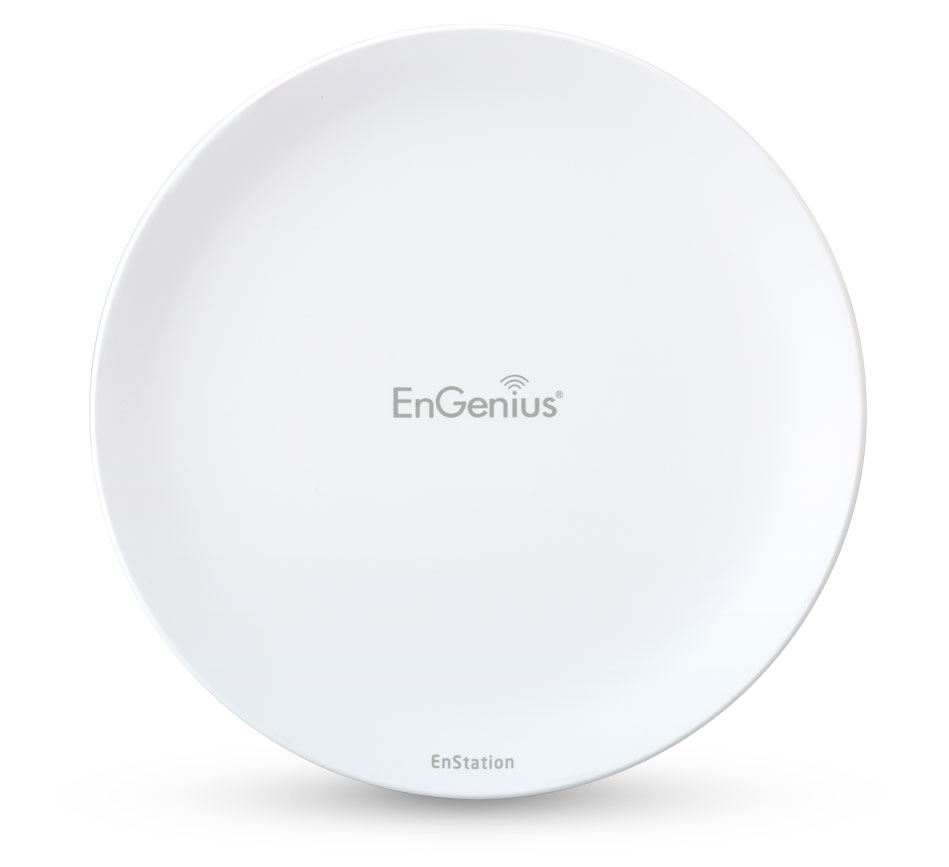
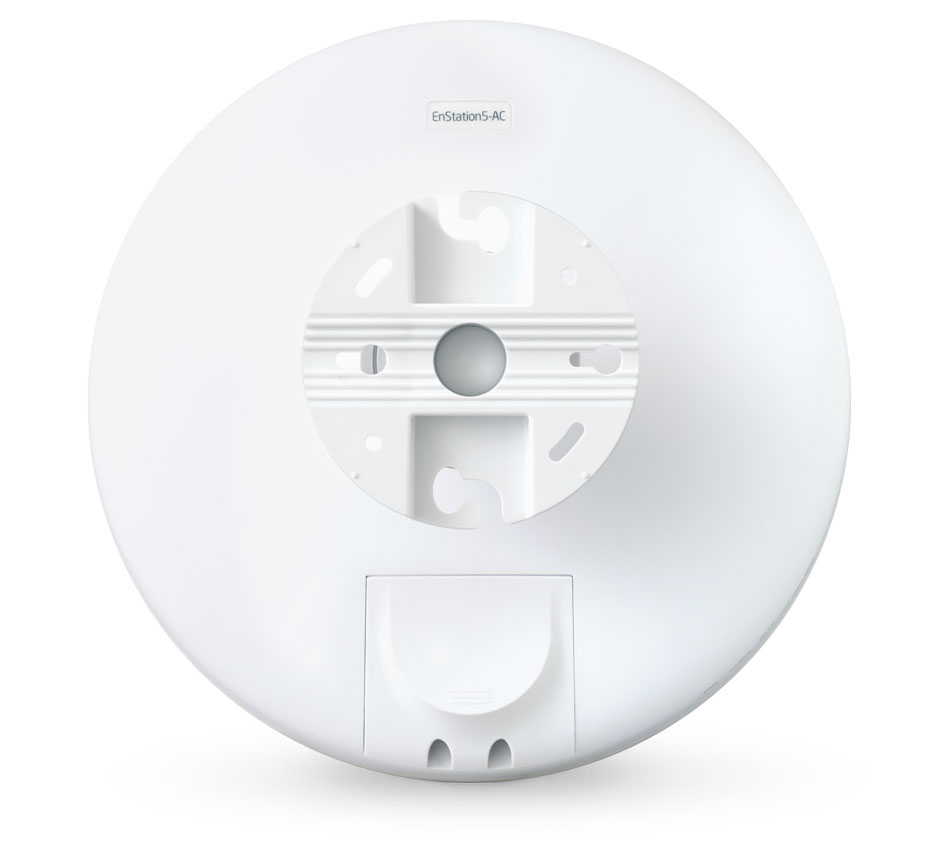
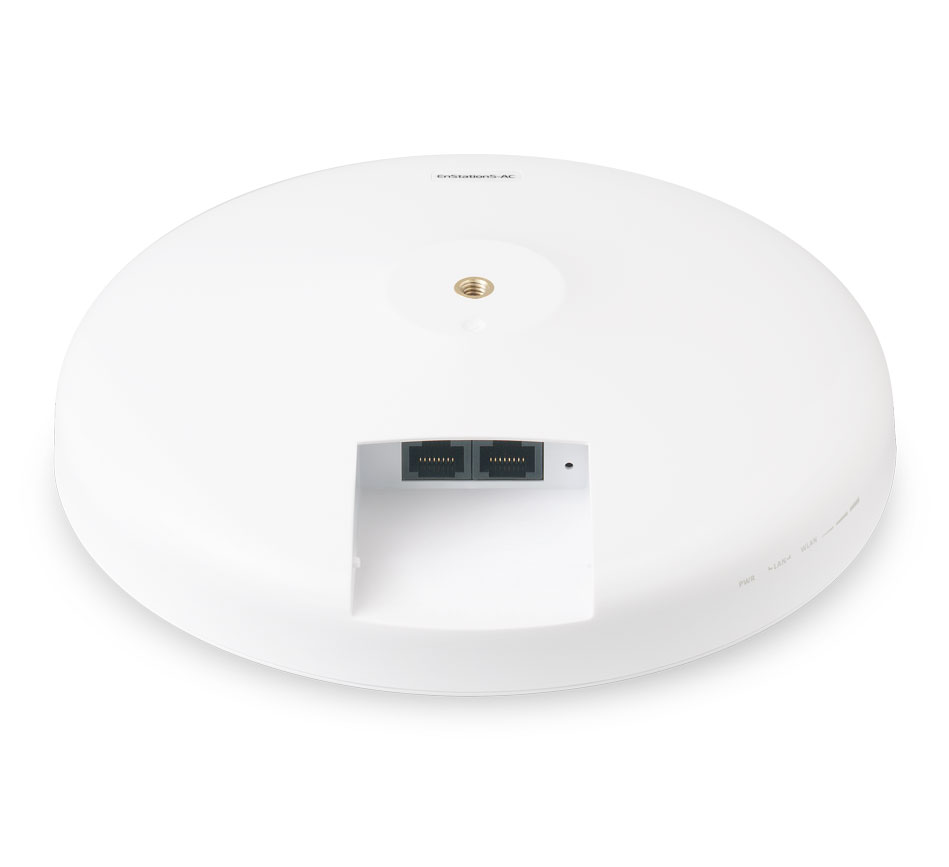
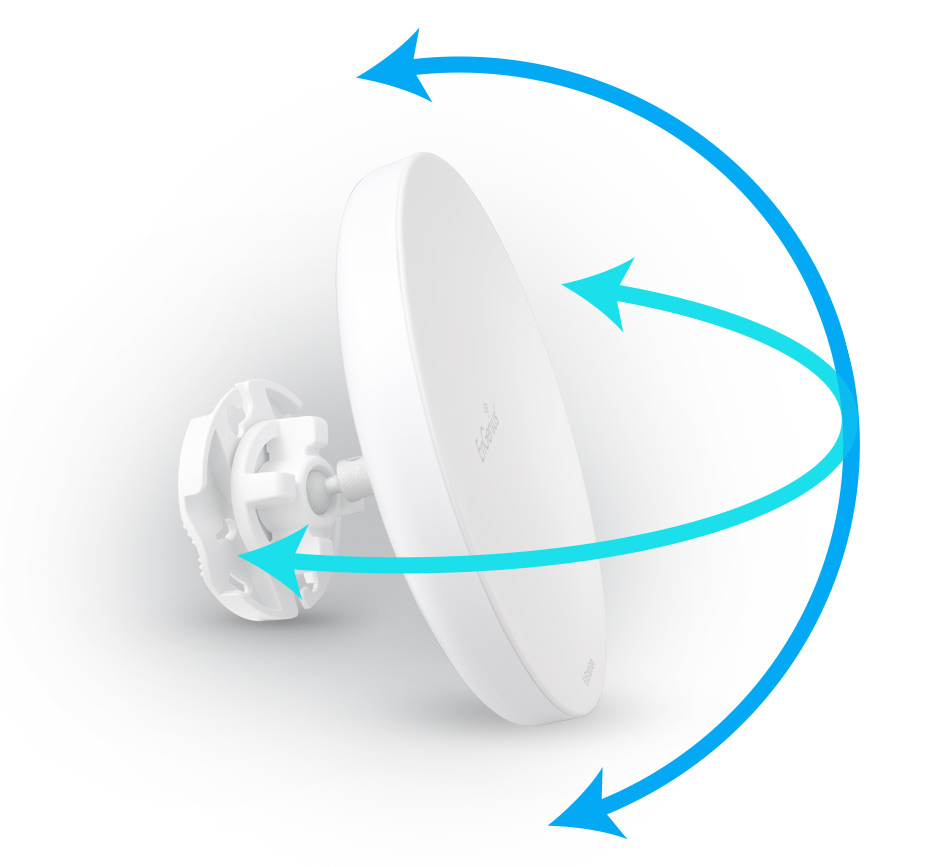
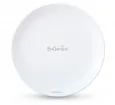

EnGenius - EnStation5-AC Kit - Two EnStation5-AC
Part number:
EnStation5-AC Kit
Price:
- • EnJet technology features Time Division Multiple Access, cutting through RF-congested environments
- • 11ac Wave 2 wireless speeds up to 867 Mbps on 5 GHz
- • MU-MIMO improves performance & increases user device capacities
- • Beamforming optimizes antenna signal, reception & reliability for device
- • High 26 dBm transmit power and high Gain 19 dBi Directional Antennas
- • IP55-Rated weatherproof & dustproof housing
- • GigE PoE port & adapter included for placement where power is limited
• EnWiFi app - Simple, Intuitive interface for AP configuring & monitoring & management
| Standards | |
|---|---|
| Wireless Standards | IEEE 802.11ac wave2/a/n on 5 GHz |
| Processor | |
| Type | Powerful Qualcomm® CPU |
| Antenna | |
| Type | High-Gain 19 dBi Integrated Directional Antennas |
| 5 GHz (Port 1) | Average Antenna Gain: 19 dBi Polarization: Linear Azimuth Beam Width: 30° Elevation Beam-Width: 18° VSWR: 1:2.0 |
| 5 GHz (Port 2) | Average Antenna Gain: 19 dBi Polarization: Linear Azimuth Beam Width: 18° Elevation Beam-Width: 30° VSWR: 1:2.0 |
| Physical Interface | |
| Ethernet Ports | 2 x 10/100/1000 Base-TX, RJ-45 Gigabit Ethernet Ports |
| Reset Button | 1 x Reset Button |
| LED Indicators | |
| Indicators | Power, LAN1, LAN2, WLAN, Signal |
| Power Source | |
| Type | Power-over-Ethernet: Proprietary 24V PoE |
| Maximum Power Consumption | 9W |
| Surge Protection | |
| Line to Line | 1 KV |
| Line to Ground | 2 KV |
| ESD Protection | |
| Contact | 4 KV |
| Air | 8 KV |
| Wireless & Radio Specifications | |
| Operating Frequency | 5 GHz |
| Operation Modes (EnJet Enabled) | Access Point Mode (AP mode) Client Bridge Mode (CB Mode) WDS: WDS AP, WDS Station |
| Operation Modes (EnJet Disabled) | Access Point Mode (AP mode) Client Bridge Mode (CB Mode) WDS: WDS AP, WDS Bridge, WDS Station |
| Frequency Radio (5 GHz) | 5180 MHz, 5200 MHz, 5220 MHz, 5240 MHz, 5260 MHz, 5280 MHz, 5300 MHz, 5320 MHz, 5500 MHz, 5520 MHz, 5540 MHz, 5560 MHz, 5580 MHz, 5600 MHz, 5620 MHz, 5640 MHz, 5640 MHz, 5680 MHz, 5745 MHz, 5765 MHz, 5785 MHz, 5805 MHz |
| Note | Support radios and channels will be varied on the configured regulatory domain |
| Transmit Power | Up to 26 dBm on 5 GHz |
| Tx Beamforming (TxBF) | Supported |
| Radio Chains/Spatial Stream | 2x2:2 |
| SU-MIMO | Two (2) Spatial Stream SU-MIMO up to 867 Mbps to a single client |
| MU-MIMO | Two (2) Spatial Stream MU-MIMO up to 867 Mbps to two (2) 1x1 wireless devices simultaneously |
| Supported Data Rates (Mbps) | 5 GHz: Max 867 802.11a: 6, 9, 12, 18, 24, 36, 48, 54 802.11n: 6.5 to 300 Mbps (MCS0 to MCS15) 802.11ac: 6.5 to 867 Mbps (MCS0 to MCS9, NSS = 1 to 2) |
| Supported Radio Technologies | 802.11a/n/ac: Orthogonal Frequency-Division Multiplexing (OFDM) 802.11n/ac: 2x2 MIMO with 2 Streams |
| Channelization | 802.11ac Supports Very High Throughput (VHT)—VHT 20/40/80 MHz 802.11n Supports High Throughput (HT)—HT 20/40 MHz 802.11n/ac Packet Aggregation: AMPDU, ASPDU |
| Supported Modulation | 802.11a/n: OFDM16-QAM, 64-QAM 802.11ac: OFDM 16-QAM, 64-QAM, 256-QAM |
| Management | |
| Multiple BSSID | EnJet Enabled: Supports 1 SSID EnJet Disabled: Supports 8 SSIDs |
| Management Interface | Management SSID – allows your mobile device such as smart phone, connect to SSID and easily configuring and monitoring through EnGenius EnWiFi App. |
| VLAN Tagging | Supports 802.1q SSID-to-VLAN Tagging |
| VLAN Pass-Through | Supported |
| Management VLAN | Supported |
| Spanning Tree | Supports 802.1d Spanning Tree Protocol |
| QoS (Quality of Service) | Compliant with IEEE 802.11e Standard WMM |
| SNMP | v1, v2c, v3 |
| MIB | I/II, Private MIB |
Name
Description
Size
Downloads
File
Data Sheet
1.9mb

EnGenius EnJet EnStation5-AC 5 GHz Outdoor 802.11ac Wave 2 Wireless Client Bridge/AP, featuring Time Division Multiple Access, cuts through RF-congested environments within Point-to-Point/MultiPoint applications. EnJet enabled the EnStation5-AC assigns time slots to each station, providing faster and more stable performance and avoiding the hidden node issue. With a high-gain 19 dBi dual-polarized directional antenna that extends the network up to 5 miles point-to-point.